Overview
A Global MedTech Case Study
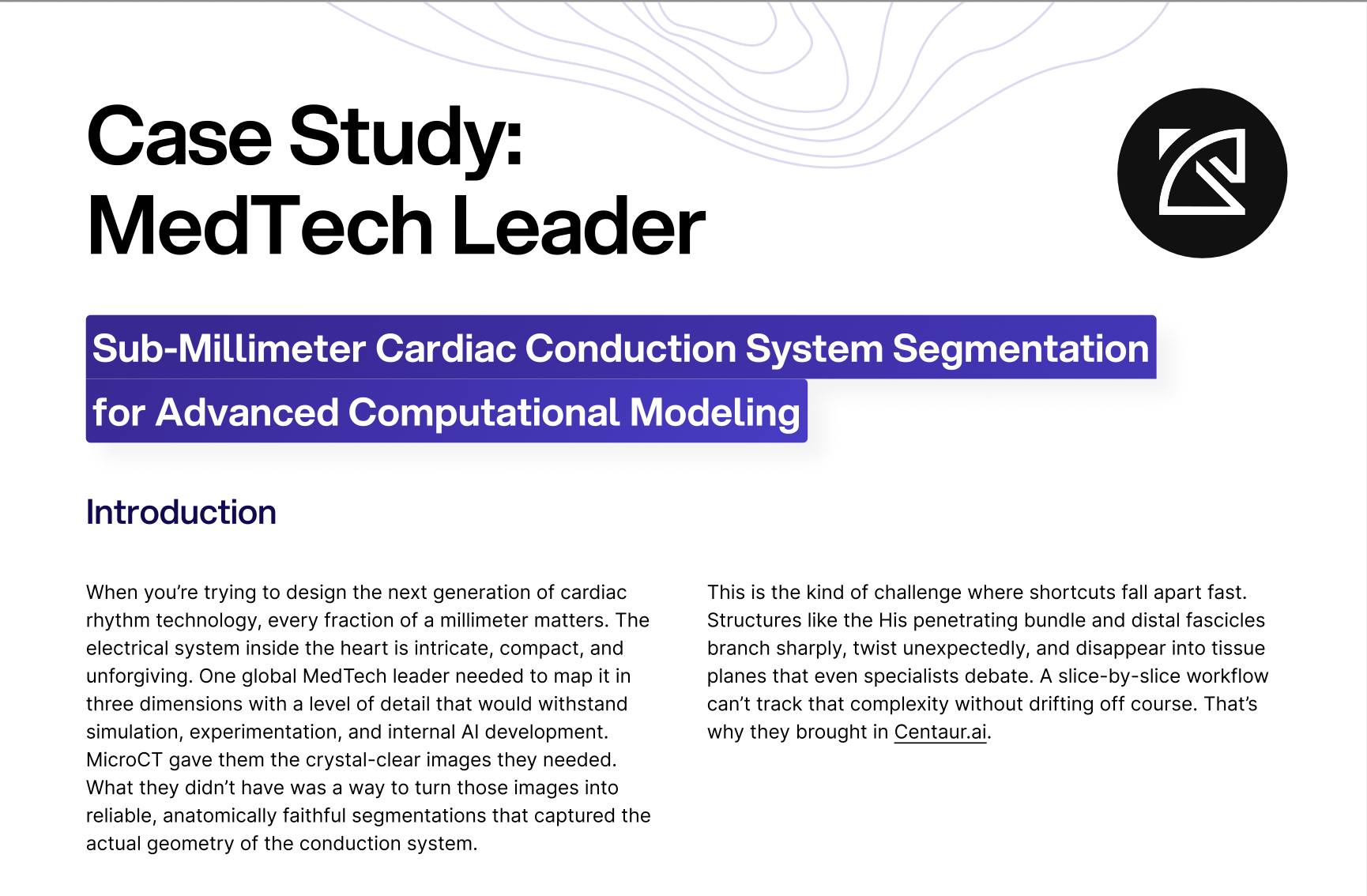
Every advanced model begins with a simple but often overlooked truth: the model can only learn what the dataset actually shows. When a system depends on anatomical structures that twist, branch, and vanish across planes shorter than a millimeter, annotation quality becomes the difference between a simulation that behaves like real tissue and one that drifts off course.
A global MedTech leader recently confronted this gap. They had crystal-clear MicroCT data but no reliable way to convert those scans into three-dimensional, anatomically faithful segmentations of the cardiac conduction system. Structures such as the atrioventricular node, His bundle, and distal fascicles do not tolerate shortcuts. A slice-by-slice workflow cannot track their geometry without accumulating errors that propagate through every downstream model.
This is the kind of challenge that exposes why annotation quality must match the resolution of the underlying imagery. Anything less introduces bias, weakens gradients, and reduces confidence in any model trained or evaluated on top of it.
Centaur.ai was brought in to solve exactly that problem.
What the Case Study Demonstrates
The project required segmenting five full MicroCT scans, each more than 5 GB, with eight separate conduction-system structures captured in continuous 3D. The client needed two outcomes: high-resolution computational models that could simulate electrical propagation with anatomical fidelity, and gold-standard training data for internal machine learning efforts.
Both goals depend on one thing: data quality that is consistent, clinically grounded, and traceable at every voxel.
To meet that bar, Centaur.ai routed the work to a single non-US cardiologist specializing in cardiac electrophysiology, supported by in-house radiologists who stepped in whenever boundaries were ambiguous. Expert disagreement was treated as a strength, not a setback. The result was a protocol refined through structured review rather than intuition or isolated judgment.
All segmentation was performed using Centaur’s strict 3D volumetric workflow, where continuity is enforced and slice-wise drift is eliminated. The outcome was a complete set of anatomically faithful structures delivered in multiple formats, supported by structure-level QC notes and metadata for full reproducibility.
Why This Matters for LLM Evaluation and Training
This case study is not merely about cardiac anatomy. It is a demonstration of a principle that generalizes across modalities.
Whether the input is image, waveform, 3D, or multimodal data, large language models trained on scientific, medical, or industrial domains require labels that reflect the real world with the same fidelity as the measurements themselves. If the annotations lag behind the complexity of the domain, the model will inherit those shortcuts. If the labels are inconsistent, the model will absorb that inconsistency.
Accuracy does not emerge at inference time. It is engineered at the annotation layer.
In environments where the model must reason about physical behavior, safety-critical systems, or subtle domain structures, annotation quality becomes a scientific variable, not an operational detail. The case study shows how disciplined workflows, vetted experts, and collaborative clinical review produce data that withstands high-stakes evaluation.
What Readers Will Learn in the Full Case Study
The downloadable case study walks through:
Why sub-millimeter segmentation is essential for credible computational modeling
How Centaur.ai leverages vetted clinical experts and structured disagreement to strengthen data integrity
The workflow rules that prevent drift, enforce continuity, and improve consistency across 3D volumes
How high-quality labels directly influence simulation accuracy and model performance
The traceability features that allow data scientists to reproduce every step of the process
It illustrates how a dataset becomes not just an input but an asset that can be trusted in production.
If your team is building models where precision is nonnegotiable, or if you need defensible ground truth for AI development, this case study offers a blueprint for how to engineer quality from the start rather than relying on calibration after the fact.
To set up a demo with us, click here
Download the case study to see how a quality-driven annotation workflow can change the trajectory of an entire AI program.