Overview
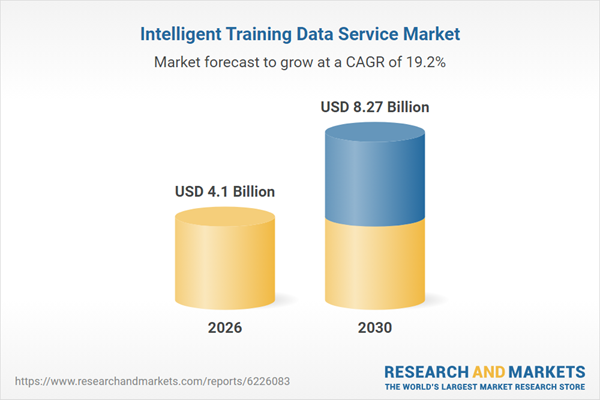
A new market report puts a number on something the industry already knows. The global Intelligent Training Data Service market will grow from $3.43 billion in 2025 to $8.27 billion by 2030, a 19.2% CAGR.
The number is not the story. The reason behind the number is the story.
For a decade, AI progress meant bigger models. More parameters, more compute, more data. That race produced real gains. It also hit a wall. Bigger stopped being enough.
Enterprise leaders now ask a harder question: Can we trust this system? Can it read a medical image correctly? Catch a defect that costs millions if missed? Make a financial or legal call without introducing unacceptable risk?
None of those are questions of scale. They are questions of AI training data quality. And that shift is what's actually fueling the market growth behind this report.
Why the training data market is booming
The report names the drivers directly: rising AI adoption, demand for high-quality annotated datasets, automated data annotation, and growth in synthetic data. Enterprise AI use jumped from 8% to 13.5% in a single year, according to Eurostat data cited in the report.
Read between those lines, and one pattern holds. Companies are not just buying more data. They are buying better data, and they are willing to pay for it.
That is a meaningful shift.
For years, data labeling got treated as a commodity: cheap, fast, outsourced, forgettable. The market growth here signals the opposite. Data quality has become a line item that boards ask about.
Bigger models did not fix the trust problem
Model scale solved a specific problem: capability. It never solved a different one: reliability in the specific case in front of you.
A model can ace a benchmark and still miss a rare tumor subtype. It can write fluent code and still hallucinate a legal citation. Scale improves averages. It does not guarantee the one answer a doctor, an engineer, or a compliance officer needed to be correct.
That gap is where "quality" stopped being a soft word and became a hard requirement. Regulators feel it too. Teams pursuing FDA clearance for an AI-enabled device cannot lean on a benchmark score. They need documented, defensible, expert-validated data behind every claim.
What quality actually requires
Most annotation still runs on a crowdsourcing model: distribute the task, average the answers, and move on. That approach optimizes for throughput. It was never built for accuracy in high-stakes domains.
Centaur.ai runs annotation differently. We treat labeling as a competition, not a queue.
- Credentialed experts and AI models label the same data independently.
- We measure performance continuously and reward the annotators who perform best.
- We combine the strongest human and AI signals into a single result, rather than averaging everyone equally.
We call the output superhuman data: more accurate than any single expert or model working alone. This is not a volunteer crowd. It is a network of >100,000+ credentialed medical professionals, competing on accuracy.
The results are measurable, not theoretical. Paige improved its pathology model's F1 score from 0.60 to 0.83 working with Centaur.ai. Eko lifted its cardiac model's AUC from 0.87 to 0.92. Those are the kinds of gains that separate a model that works in a demo from one that works in production.
Quality is the deciding factor for regulated AI
In medical devices, life sciences, and other regulated industries, quality is not a differentiator. It is the entry requirement.
An AI system needs more than a working model. It needs annotation with full provenance: who labeled it, how disagreement was resolved, and how confident the label really is. Teams that treat annotation as an afterthought discover this the hard way, usually during a submission review, not before it.
The training data market's growth reflects that reality spreading across every industry building high-stakes AI, not just healthcare. Finance, insurance, robotics, and manufacturing are all running into the same wall: a model is only as trustworthy as the data behind it.
The quality era is here
The forecast in this report is a symptom. The real story is the shift underneath it: AI is no longer judged by how big the model is. It is judged by how much you can trust the answer.
That is the quality era. And it rewards teams who treat data quality as infrastructure, not an afterthought.
See what quality-first annotation looks like for your AI. Book a demo with Centaur.ai and find out how competitive, expert-validated data can move your model from working to trustworthy.