Overview
A single mission unites every radiologist attending RSNA this year: advancing patient care through improved imaging technology. But as models grow more powerful and multimodal, their performance is only as strong as the data they learn from. The quality of annotation—not the quantity of images—has become the decisive factor in whether radiology AI succeeds or fails in real-world use.
Why Data Annotation Quality Matters
Training and evaluating large language models (LLMs) for radiology isn’t just about labeling images; it’s about capturing nuanced patterns that mirror clinical reasoning. A model trained on inconsistent or poorly verified annotations can misclassify findings, miss subtle pathologies, or fail to generalize across patient populations. In radiology, where outcomes directly impact lives, there is no margin for approximation.
That’s why leading institutions and enterprises turn to Centaur.ai. Our platform combines collective intelligence with rigorous performance benchmarking to ensure every label reflects expert consensus. By comparing multiple annotator reads and rewarding accuracy through gamified quality control, Centaur delivers an unprecedented signal-to-noise ratio in radiology data.
Proven Accuracy at Scale
Our results at Centaur.ai aren’t theoretical: they are proven. Our radiology labeling networks achieve results that rival top experts:
- 100,000 classifications per day across X-ray datasets with three reads per case and 99 percent interrater agreement
- 24,000 segmentation boxes per day with five reads per case and 91 percent agreement
- 4,000 radiology report highlights per day with 93 percent interrater agreement
- This combination of speed, scale, and precision enables healthcare AI developers to train and validate models that genuinely perform in clinical environments.
Built for Healthcare, Trusted by Leaders
Centaur’s system is designed specifically for medical data. The platform supports DICOM radiology viewers, HIPAA and SOC 2 Type 2 compliance, and complex modalities including MRI, CT, ultrasound, and radiology text reports. With over 58,000 vetted medical professionals contributing millions of annotations weekly, Centaur empowers model developers to move from uncertainty to reproducible, evidence-backed performance.
Our research collaborations with major institutions have demonstrated that expert crowds can outperform individual experts in diagnostic accuracy. The result: data that reflects the collective intelligence of the field rather than the variability of a single reader.
Why RSNA Attendees Should Visit Centaur.ai
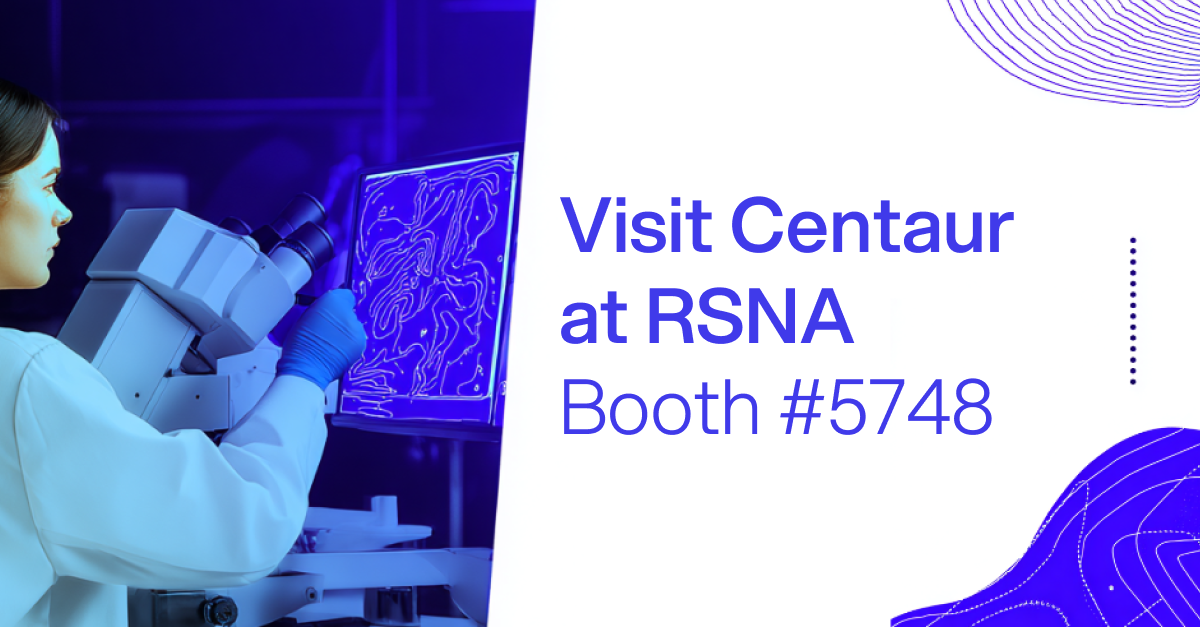
At this year’s RSNA, Centaur.ai will be in Booth #5748, showcasing how collective intelligence transforms radiology model development. From fine-tuning LLMs for report summarization to generating benchmark datasets for multi-modal AI, attendees can see firsthand how Centaur’s annotation system elevates both model training and evaluation.
If your radiology AI pipeline depends on accurate ground truth, Centaur.ai is where quality becomes inevitable—not aspirational.