Overview
A recent Forbes article offered a revealing look at OpenAI's growing ambitions in healthcare. The company has launched multiple healthcare-focused products, recruited hundreds of physicians to improve model performance, and now treats healthcare as one of its most important strategic verticals.
None of this should come as a surprise. Healthcare represents nearly one-fifth of the U.S. economy, and AI has the potential to improve everything from administrative workflows and clinical documentation to diagnosis, treatment planning, and patient engagement. Every major AI company recognizes the opportunity.
The Next Competitive Advantage
One detail deserves more attention than it received: OpenAI has assembled a network of more than 260 physicians who have collectively reviewed hundreds of thousands of AI responses to improve its healthcare models. That isn't simple quality assurance. It's recognition of a fundamental reality that every organization building healthcare AI eventually discovers.
No healthcare AI model outperforms the human judgment behind it
For years, the AI conversation has centered on model capabilities: which model scores highest on benchmarks, which reasons better, and which generates the most accurate answers. Those questions still matter, but they're becoming less differentiating as frontier models continue to improve.
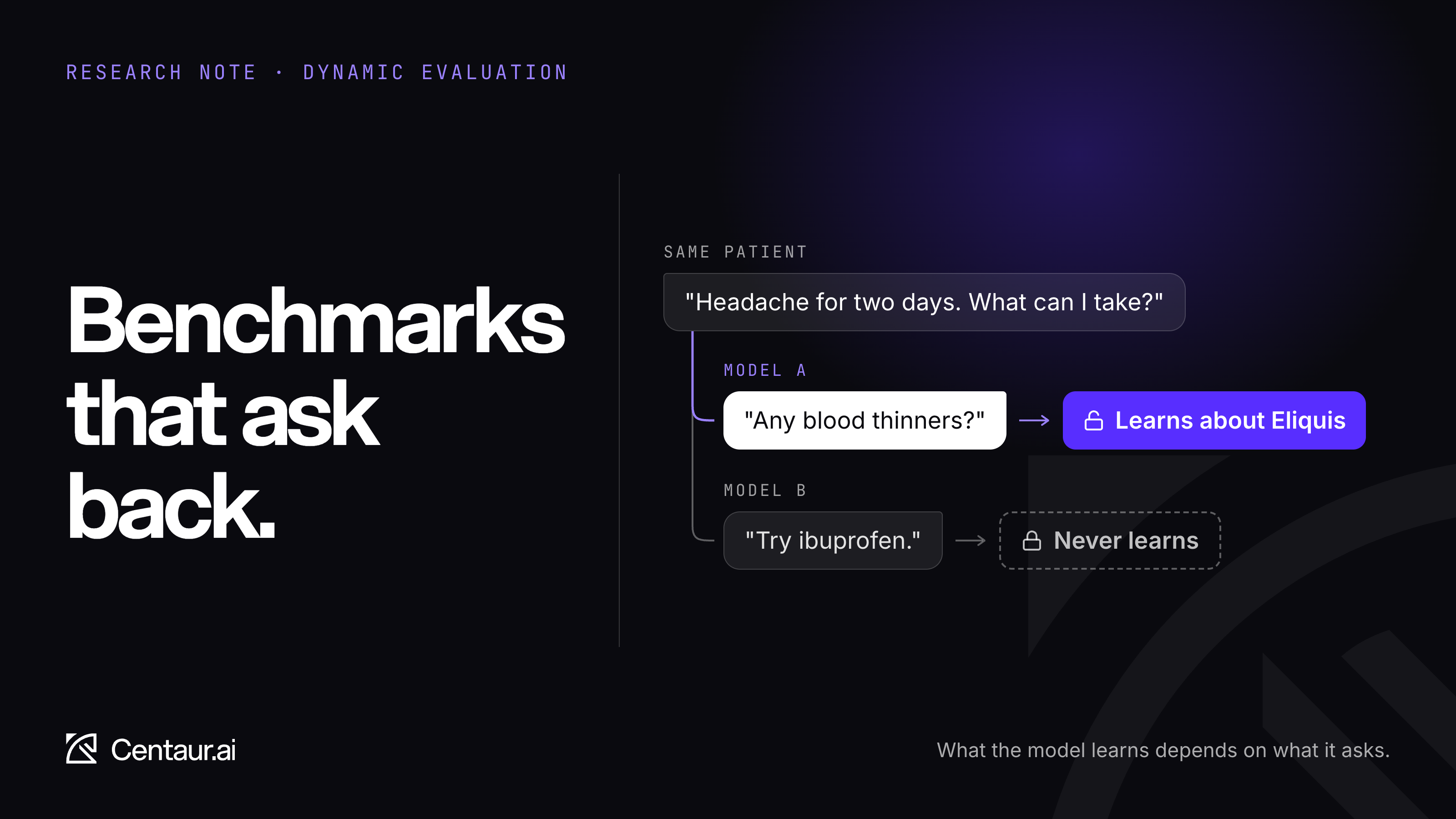
Healthcare organizations are now asking a different set of questions: Why should we trust this output? How was it evaluated? Can performance be measured consistently? Can decisions be audited? None of those questions can be answered by the model alone; they're ultimately questions about data quality and the human expertise behind it.
Ground Truth Doesn't Create Itself
Before an AI system can identify a tumor, interpret a pathology slide, summarize a clinical encounter, or recommend a treatment pathway, experts must first establish what "correct" actually looks like. They decide which examples belong in the training data, how those examples should be labeled, where reasonable clinical disagreement exists, and how success should be measured.
Without expert judgment, there is no reliable ground truth. Without reliable ground truth, there is no trustworthy AI.
Healthcare Doesn't Need More Data. It Needs Better Judgment
Healthcare doesn't suffer from a lack of data. Medical imaging archives, pathology slides, clinical notes, physiological waveforms, lab results, and electronic health records already exist at enormous scale. The challenge isn't collecting more information. It's ensuring that information is accurate, consistent, and labeled by the right experts.
As AI moves beyond administrative efficiency into diagnosis and treatment decisions, the quality of every annotation becomes part of the clinical product itself. A model can only learn from the examples it's given. If those examples contain inconsistencies or poorly defined ground truth, those limitations become part of the model's behavior.
Consensus Is a Quality Signal
Medicine introduces a complexity that many outside healthcare underestimate: experts don't always agree. Radiologists interpret difficult findings differently. Pathologists disagree on borderline cases. Specialists approach challenging diagnoses from different angles.
That disagreement isn't a flaw in medicine; it's part of practicing medicine. The highest-quality healthcare datasets don't try to eliminate that reality; they measure it. They identify where consensus exists, where uncertainty remains, and how confidence should be represented. Understanding disagreement is often just as valuable as understanding agreement, because it produces models that better reflect real clinical practice.
Quality Must Be Measurable and Auditable
As healthcare AI matures, organizations will evaluate training data with the same rigor they apply to clinical evidence. They'll want to know who created the annotations, how expert performance was measured, how consensus was established, and whether every decision can be audited.
Those are no longer academic questions. They're becoming procurement questions.
This is why we've long believed at Centaur that human expertise isn't simply an input into AI development; it's a strategic asset. Building competitive expert networks, continuously measuring annotation quality, capturing consensus, and creating transparent evaluation pipelines are foundational capabilities for any organization developing AI in a regulated industry.
Trust Is the Next Differentiator
The Forbes article shows that even the world's leading AI companies recognize this shift: better models require better human expertise behind them. As frontier models continue to improve, raw intelligence will become increasingly commoditized. Trust will become the differentiator.
Trust doesn't come from larger parameter counts or faster inference times. It comes from the quality of the human judgment used to train, evaluate, and continuously improve AI systems.
Because every great healthcare AI model is built on human judgment.