Healthcare’s Moment of Operational Reality
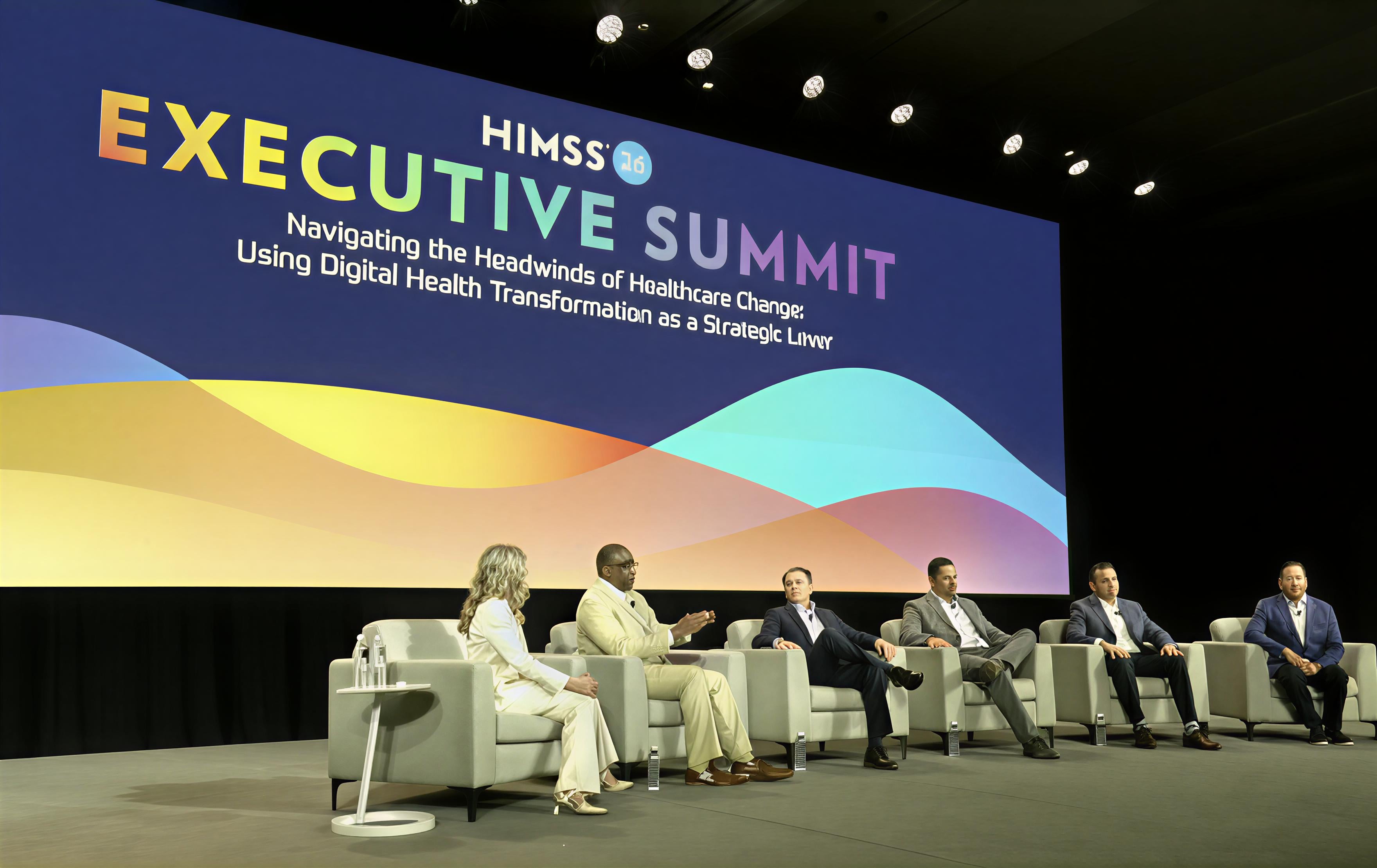
The 2026 HIMSS Executive Summit kicked off this morning with an emerging message from a panel of healthcare leaders:
Artificial intelligence is no longer confined to research labs or innovation programs.
It is increasingly moving into the operational core of medical systems.
Organizations today are navigating one of the most complex periods in healthcare in decades. Hospitals are operating under intense financial pressure. Workforce shortages continue to strain clinical teams. Meanwhile, expectations for digital transformation have only increased. Against that backdrop, health systems are being forced to rethink how they evaluate investments in new technology.
From Innovation Theater to Verifiable Outcomes
One of the most striking themes from the panel discussion was the growing scrutiny surrounding healthcare technology investments. For much of the past decade, healthcare organizations were encouraged to experiment with digital tools and emerging technologies. Pilot programs proliferated. Innovation labs explored new possibilities. Venture funding poured into healthcare AI startups.
But economic and functional realities have increased accountability. Today, healthcare leaders are requesting clear alignment between digital initiatives and quantifiable effects for both patients and the organization. AI projects must now demonstrate their value in terms that healthcare executives understand: improved clinical outcomes, minimized operational friction, increased efficiency, and measurable financial impact. That standard is changing how organizations evaluate and deploy artificial intelligence.
The Shift from AI Experimentation to Deployment
When asked which technology priorities health systems are focusing on right now, panelists said the conversation has shifted from experimenting with AI to operational deployment. Organizations are asking how these tools fit into real healthcare workflows. The industry is moving beyond proof-of-concept models toward systems that must function reliably within hospitals, clinics, and diagnostic workflows.
Operational AI introduces new requirements. Models must perform consistently across diverse patient populations. Predictions must be interpretable and trustworthy for clinicians. Systems must integrate effectively into existing clinical workflows without adding complexity. Most importantly, the models must be trained on data that reflects the realities of clinical practice. This is where the conversation often turns from algorithms to data. AI models can only be as reliable as the datasets used to train them. When healthcare organizations deploy AI in actual environments, the weaknesses of the underlying data become immediately apparent. Missing annotations, inconsistent labeling, and limited representation of edge cases can quickly undermine model effectiveness. Operational deployment raises the bar for data quality.
Why Data Quality Determines AI Success
At Centaur.ai, we see this shift every day in conversations with healthcare-related AI teams. As organizations move from experimentation to deployment, the bottleneck is rarely the model architecture. More often, it is the quality of the training data.
Healthcare data is inherently complex. Medical images contain subtle diagnostic signals that require expert interpretation. Clinical data sets must represent diversified populations, imaging devices, and disease presentations. Edge cases must be identified and labeled accurately. Producing these datasets calls for collaboration between machine learning engineers and clinical experts. Automated approaches alone cannot capture the nuance required for high-stakes medical AI.
This is where collective intelligence becomes essential. By combining scalable data infrastructure with networks of expert medical annotators, organizations can produce the high-quality datasets required for operational AI systems. Expert review ensures that labels reflect the real clinical interpretation rather than simplified approximations. Structured workflows enable the capture of rare conditions and edge cases that models must recognize in production.
The result is not simply improved model accuracy. It is the foundation for trustworthy AI systems that clinicians can rely on in real decision-making scenarios.
The Next Phase of Healthcare AI
The conversation at the HIMSS Executive Summit reinforced a critical reality for the industry. AI has crossed an important threshold. Healthcare organizations are no longer asking whether artificial intelligence will play a role in clinical care; they are asking how. They are asking how to deploy it safely, effectively, and at scale. That transition changes the priorities for everyone involved in building these systems.
Model innovation will remain important, but the organizations that succeed in this next phase will be those that invest in the foundations of reliable AI. High-quality datasets, expert annotation workflows, and rigorous validation processes will determine whether AI systems perform consistently across real clinical environments.
As healthcare leaders made clear at HIMSS, the future of clinical AI will not be determined solely by algorithms. It will be defined by the quality, integrity, and expertise embedded in the data that powers them.
Next Steps
Stop by booth #11222 for live demonstrations, product showcases, and conversations with the Centaur AI team, or schedule a private demo on site here.