Overview
The Milestone
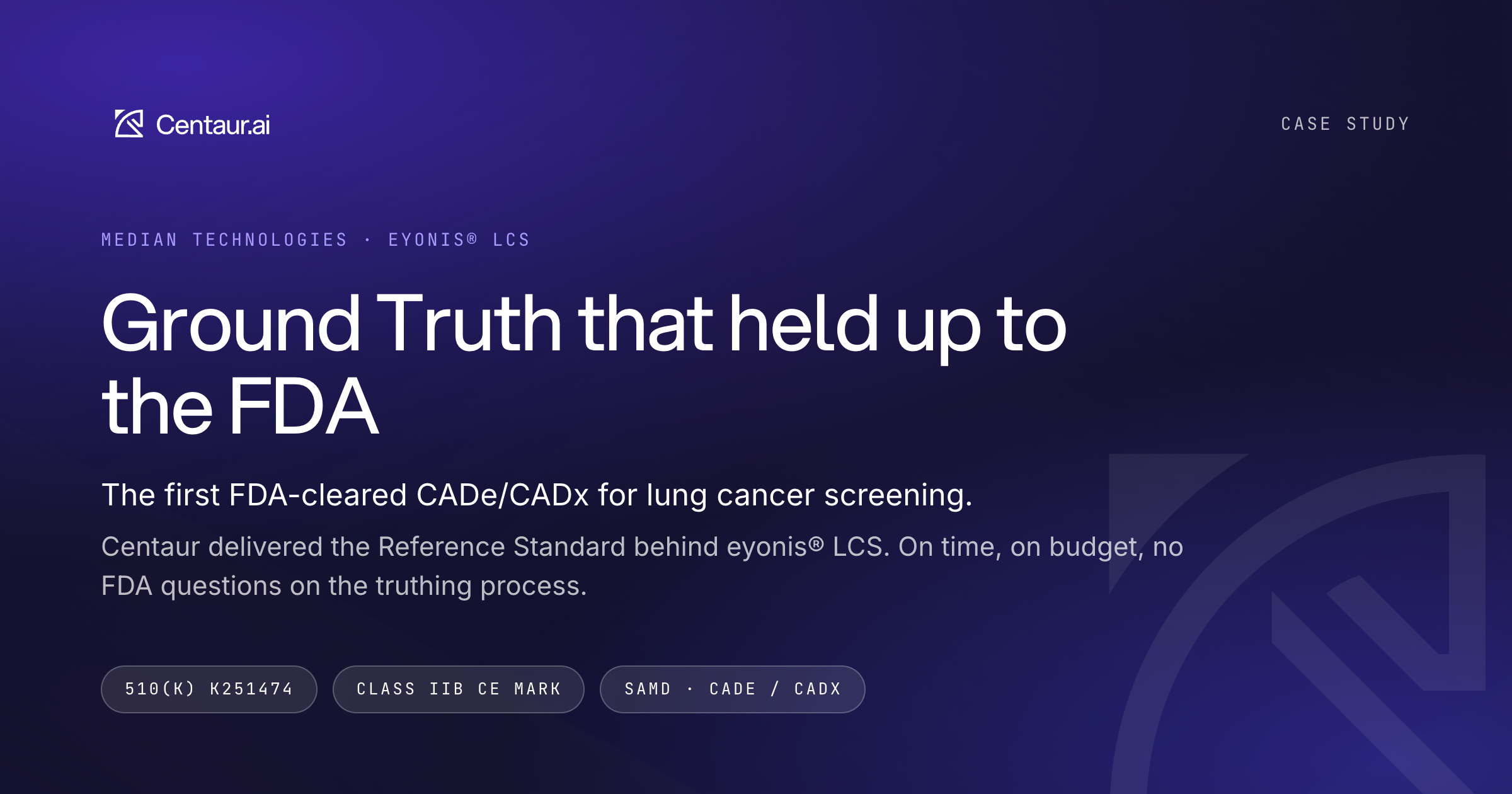
Median Technologies was granted FDA 510(k) clearance (K251474) for eyonis® LCS, an AI/ML technology-based end-to-end CADe/CADx Software as a Medical Device (SaMD), in February 2026. In July, Median also obtained Class IIb CE marking.
Median Technologies has now put in place all the key pieces to redefine lung cancer screening in the U.S. and in Europe, potentially helping save hundreds of thousands of lives. These pieces include:
- The eyonis® LCS Software as a Medical Device (SaMD), which supports lung cancer diagnosis at early, curable stages, has 510(k) clearance K251474 and Class IIb CE marking, enabling Median Technologies to market the solution in the U.S and Europe.
- An available US CPT reimbursement code (NT-APC 1508) that creates a reimbursement pathway for hospitals to invest in lung cancer screening programs.
- A first commercial agreement with Tempus for an integration in the clinical workflow via the Tempus Pixel platform, and another one with Canon Medical Systems Corporation’s Olea Medical.
As part of its successful strategy to help change lung cancer screening in the U.S., Median Technologies focused its efforts on what mattered most: building a powerful lung screening model.
As is often the case with complex technology solutions, Median Technologies realized it could not do everything on its own and chose to partner with Centaur.ai to help solve the important and difficult, but not core, problem of Ground Truth labeling by U.S. board-certified thoracic radiologists.
Centaur delivered the Ground Truth labels on time and on budget, which played an important role in eyonis® LCS obtaining both 510(k)clearance and Class IIb marking. This case study outlines details of Median Technologies and Centaur’s successful partnership.
The U.S. Radiologist Deficit
U.S. radiologists have been under stress for several years, and it’s only getting worse. It comes down to supply and demand: the radiologist workforce can’t keep up with the volume of medical imaging.
In 2025, AuntMinnie.com named radiology workforce shortages as the biggest threat to radiology for the third year in a row. At the same time, according to a recent Neiman NPI study, radiologist attrition rates (i.e., leaving the workforce) more than doubled from 1.1% to 2.5% from 2014 to 2022.
Subspecialty radiologists experienced particularly high attrition, with a 37% higher rate between 2014 and 2022 than other radiologists. The bottom line is that radiologists in the U.S. are busy and in demand, and subspecialty radiologists are even busier and in greater demand.
The Solution
In this context, trustworthy AI assistance has the potential to make a real difference. However, CADe systems can overwhelm radiologists with large numbers of candidate findings, while CADx require them to first locate regions of interest.
eyonis® LCS was designed to address both challenges at once, combining detection and characterization into a single, integrated SaMD CADe/CADx solution.
The eyonis® LCS medical device detects, localizes, and characterizes pulmonary parenchymal nodules from LDCT DICOM images produced during chest CT examinations in order to aid cancer diagnosis and improve clinical management of patients. The eyonis® LCS device runs automatically, and its output is embedded in the radiologist's workflow. Each flagged lung nodule is displayed in the eyonis® LCS result report that is appended to the end of the study with the following information: slice number, malignancy score, full snapshot, close-up snapshot, diameters (long/short/average), and volume.
At the time of this publication, eyonis® LCS is the only device capable of both detecting and characterizing lung cancer in low-dose CT scans, with 93.3% sensitivity, 92.4% specificity, and 99.9% Negative Predictive Value.
The Regulatory Reality: Measure Twice, Cut Once
For AI medical device companies classified as Class II by the FDA, the 510(k) clearance process is a necessary hurdle to commercialization.
First, the company must define its device’s intended use. Then, the company must find a predicate device that already has its 510(k) clearance and is substantially equivalent to the target device. For eyonis® LCS, Median Technologies had to request the FDA’s input (since no CADe/CADx for lung cancer had been cleared before) and ScreenPoint Medical B.V.’s Transpara™ 2.1.0 was selected (QDQ product code). Further to this, the company must objectively prove that its device works as described in its intended use, is substantially equivalent to the predicate (despite it being intended for a different organ) and show a net positive clinical value and positive risk benefit/ratio.
All of these elements, along with many more, are bundled into the device’s 510(k) application, which is then reviewed by the FDA (CDRH).
In Centaur and Median Technologies’ experience, the FDA’s Q-Sub process is extremely valuable. The Q-Sub is a pre-submission process, consisting of one or more meetings with the FDA to review the company’s application plan, including the device’s intended use, the predicate device, and the pivotal validation protocol used to demonstrate that the device works in line with its intended use. In the Q-Sub, the FDA will either not make any major objection to the plan as is or recommend specific changes.
This feedback is extremely precious, and though not binding, receiving and implementing these FDA’s recommendations significantly increases the chances of a positive outcome. It is the classic “measure twice, cut once.”
The FDA aims to review 510(k) applications within 90 days of submission. While complex AI devices may involve additional information requests that extend this timeline, proactive Q-Sub engagement helps keep reviews efficient. Here is a link to eyonis® LCS 510(k).
The process differs significantly for CE-marking, as manufacturers are required to go through a Notified Body. Median chose the French notified body GMED, and demonstrated compliance with the highest European standards for patient safety and clinical efficacy: the same rigor and attention to details is required to pass through the process. Having done solid work on the pivotal studies without a doubt helped along with the CE-Marking submission and technical dossier review.
Powering Performance Evaluation
To obtain 510(k) clearance, two complementary types of evaluations were required:
- A standalone performance evaluation, designed to measure how accurately and robustly the tool performs across a wide range of clinically relevant cases
- A Multi-Reader Multi-Case (MRMC) study, designed to assess how useful the tool is in real-world practice, with multiple board-certified radiologists interpreting the same cases both with and without AI assistance
Both evaluations rely on a critical foundation: a Reference Standard, establishing the Ground Truth (GT) against which performance can be measured. Building and validating this Reference Standard was led by Benjamin Renoust’s Data and Knowledge Engineering team at Median Technologies.
For the evaluation to be both accurate and acceptable from a regulatory standpoint, the Ground Truth process had to follow a rigorous, fully specified protocol. This protocol was designed to minimize reader subjectivity and ensure consistency across cases, and included:
- A multi-stage annotation workflow, with clearly defined roles (e.g., primary readers, adjudicators)
- Strict blinding and independence rules, preventing bias between readers
- Carefully defined annotation guidelines, ensuring consistency in nodule detection, segmentation, and characterization
- Adjudication steps, to resolve disagreement and converge toward a reliable reference
- Full traceability and documentation, creating an auditable chain of evidence for the FDA
The process was not only complex but also required scale. A large number of expert radiologists needed to work in parallel to meet timelines, while still maintaining the highest quality standards.
This is where Centaur’s contribution was critical.
Beyond simply sourcing radiologists, Centaur helped ensure that the right experts were selected for each role in the protocol. This included identifying thoracic US board certified radiologists with the appropriate level of experience and subspecialty training, proposing multiple qualified candidates, and carefully screening for conflicts of interest and long-term availability.
Equally important was the ability to rapidly onboard and align these experts on a demanding and highly specific protocol. Centaur supported this process by bringing in radiologists who were already familiar with structured annotation workflows and who could quickly adapt and contribute effectively.
As Benjamin Renoust explained:
“Partnering with Centaur allowed Median to stay focused on what mattered most—quality control, developing the evaluation pipelines, and building the Ground Truth itself—without having to manage the complexity of coordinating radiologists. This made it possible to implement a robust Reference Standard and deliver a fully documented, auditable annotation process with a clear chain of objective evidence for our performance claims, which was ultimately accepted. Importantly, neither the FDA nor the GMED did raise any major questions about the truthing process.”
Through this approach, the team was able to generate a high-quality Reference Standard that supported both the standalone and MRMC evaluations, demonstrating not only the model’s performance, but also its clinical value in assisting radiologists in making critical, life-saving decisions.
Does Anyone Enjoy Creating Pixel-Perfect Segmentations?
The work of a diagnostic radiologist includes identifying, describing, measuring, and characterizing disease and other problems. This is important, time-sensitive, and directly in the clinical care pathway work.
Creating Ground Truth for a solution like eyonis® LCS requires qualified experts to create pixel-perfect segmentations, which is a task that radiologists never perform as part of their clinical work. Only a subset of radiologists is interested in the meticulous, time-intensive, and mentally demanding effort required for pixel-perfect segmentation of lung tumors.
Through its vast experience across hundreds of projects, Centaur has built a large network of medical specialists (e.g., radiologists, cardiologists, sonographers, rad techs, and more) who are qualified experts under the FDA’s definition. These specialists are also skilled at and enjoy this type of segmentation work.
Significantly, they also enjoy working on medical devices designed to change and improve the way radiology is practiced. They enjoy working on medical devices like the eyonis® LCS’s target.
For the eyonis® LCS ground truth project, Centaur assembled a team of 14 seasoned thoracic radiology labeling pros who understood the work. These specialists had done this type of work previously and, as a result, understood the timing and effort-level requirements.
Because it was the "right team with the right experience and the right expectations," this team delivered the Ground Truth labels that ultimately helped attain 510(k) clearance for eyonis® LCS on time and on budget. In addition, the team reported that they genuinely enjoyed working on the project.
Outcome and Impact
When Median Technologies obtained its FDA 510(k) clearance for eyonis® LCS (K251474) on February 6, 2026, it took a significant step toward its goal of redefining lung cancer screening and potentially saving lives. With this clearance achieved, Median Technologies now has the following pieces in place as part of its go-to-market strategy:
- The eyonis® LCS solution, which supports lung cancer diagnosis at early, curable stages, has 510(k) clearance K251474, enabling Median Technologies to market it in the U.S.
- An available CPT reimbursement code (NT-APC 1508) that creates a financial pathway for hospitals to invest in lung cancer screening programs.
- Integration in the clinical workflow available through the Tempus Pixel platform.
- The work done on the pivotal studies helped accelerate through the Class IIb CE marking, obtained on July 3, 2026.
- Partnering with Canon Medical Systems Corporation’s Olea Medical will make the solution available both in any country requiring any of the FDA clearance or CE marking.
Building an AI model that works on the bench is an impressive accomplishment, but it is only the first step toward successfully bringing an AI medical device solution to market. Healthcare AI companies must also develop a plan to get their solution cleared by the FDA and define a path that makes hospitals interested in adopting it.
Most companies cannot do everything on their own. They need to select partners who can help them address the nonessential yet very important problems involved in bringing an AI medical device to market.
For eyonis® LCS, Median Technologies partnered successfully with Centaur.ai. As a result, eyonis® LCS is positioned to redefine the lung cancer screening market and help save hundreds of thousands of lives in the U.S. alone.