Overview
Why Smarter Energy and Climate AI Starts with Smarter Data
Across wind farms, solar arrays, flood zones, and forests, machine learning models are increasingly relied upon to interpret satellite images, forecast emissions, and direct energy resources. But while the headlines focus on model architectures and AI breakthroughs, the real progress depends on something more foundational: the quality of the data used to train and validate these systems.
At Centaur.ai, we believe energy and climate intelligence can only be as accurate and actionable as the labels behind it. Whether it’s identifying microfractures in turbine blades or classifying patterns of land use change from space, model performance hinges on precisely annotated, edge-aware, human-informed data.
Unlike other domains, environmental and infrastructure data vary not just by region but also by season, altitude, weather patterns, and camera angle. That’s why traditional labeling approaches often fall short. Systems trained on last month’s sunny drone footage may fail under this month’s snowy satellite pass.
Centaur’s collective intelligence model solves for this. By engaging a distributed network of expert validators and combining their insights with quality assurance algorithms, we enable adaptive labeling pipelines tuned to the specific edge cases of climate and energy use. This is not generic data at scale—it’s calibrated insight at depth.
For example, using Centaur.ai, customers can:
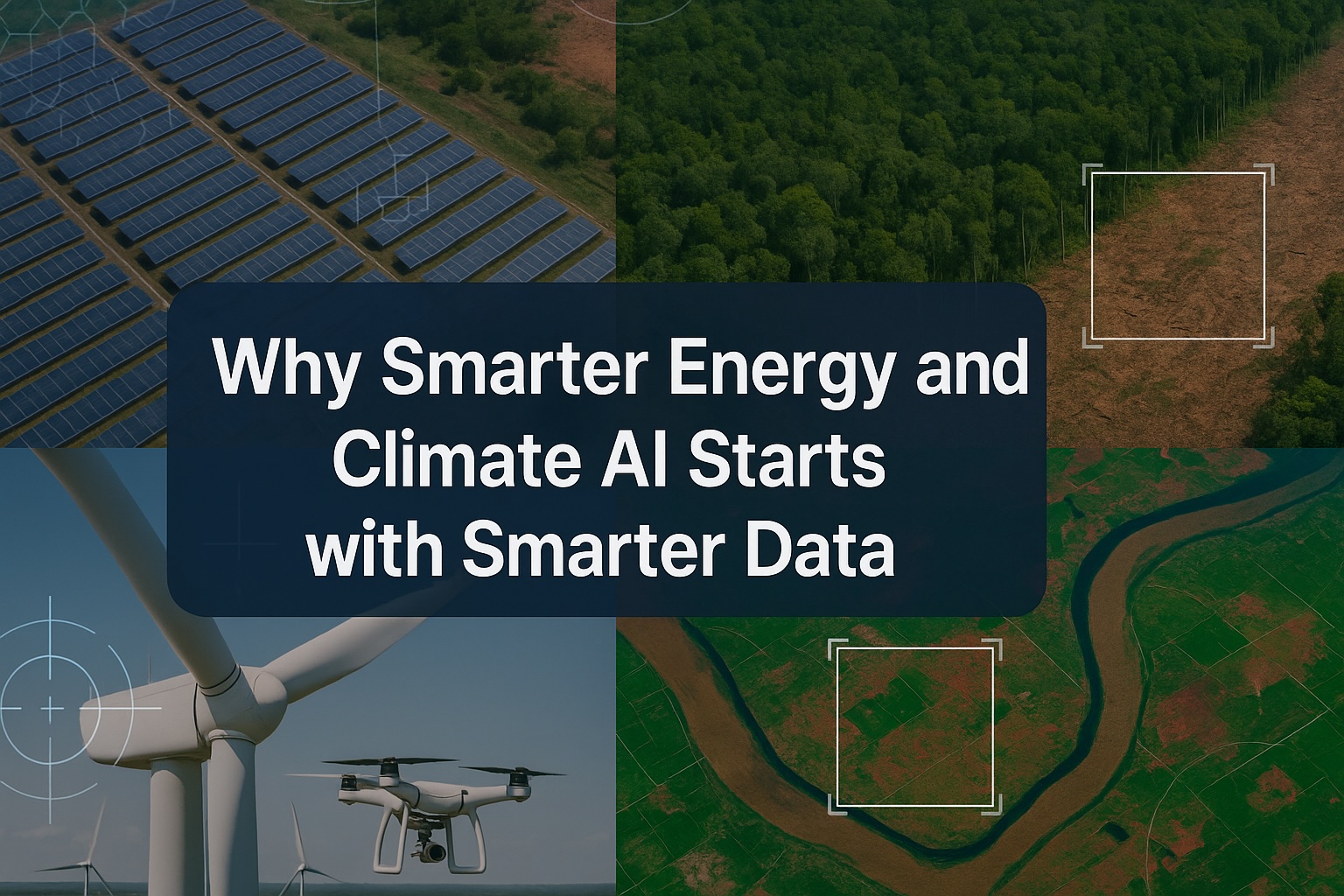
- Tag satellite imagery for land use classification, flooding patterns, or deforestation markers
- Validate outputs from climate risk models against human ground truth.
- QA image streams from drones inspecting solar installations or wind farms
- Monitor encroachment risks near pipelines or power infrastructure
- Benchmark AI model predictions against expert-reviewed visual datasets
In sectors where the stakes are planetary, not just operational, every annotation matters. A mislabeled frame might hide a rising riverbank, and a misclassified segment might misrepresent a growing wildfire front. In these contexts, accuracy isn’t a nice-to-have. It’s a limiter on action, trust, and policy.
Centaur.ai was built for this kind of mission-critical labeling. As the planet changes, the only AI systems that will remain useful are those grounded in rigorously labeled, expertly validated data.
For a demonstration of how we can facilitate your AI model training and evaluation with greater accuracy, scalability, and value, Schedule a demo with Centaur.ai