Why High-Quality Data is the Real Game-Changer
Content moderation has become one of the most pressing challenges for digital platforms. With user-generated content proliferating across forums, social media, comment sections, and streaming apps, the responsibility to identify and remove harmful, misleading, or offensive material has grown exponentially. While AI is often deployed to scale these efforts, the effectiveness of any moderation system depends on the quality of the training data behind it.
At Centaur.ai, we believe that high-quality data annotation is the cornerstone of safe and reliable AI moderation systems. Without it, even the most advanced algorithms risk being inconsistent, biased, or ineffective.
Why Platforms Are Under Pressure
Global platforms are expected to uphold safety, comply with regulations, and preserve user trust. Moderation mistakes can result in reputational harm, regulatory penalties, and even real-world consequences. Scaling moderation with AI is no longer optional, but it cannot be done responsibly without datasets that capture nuance and context. From hate speech to disinformation and explicit imagery, the stakes are high.
The Role of Annotation in Moderation
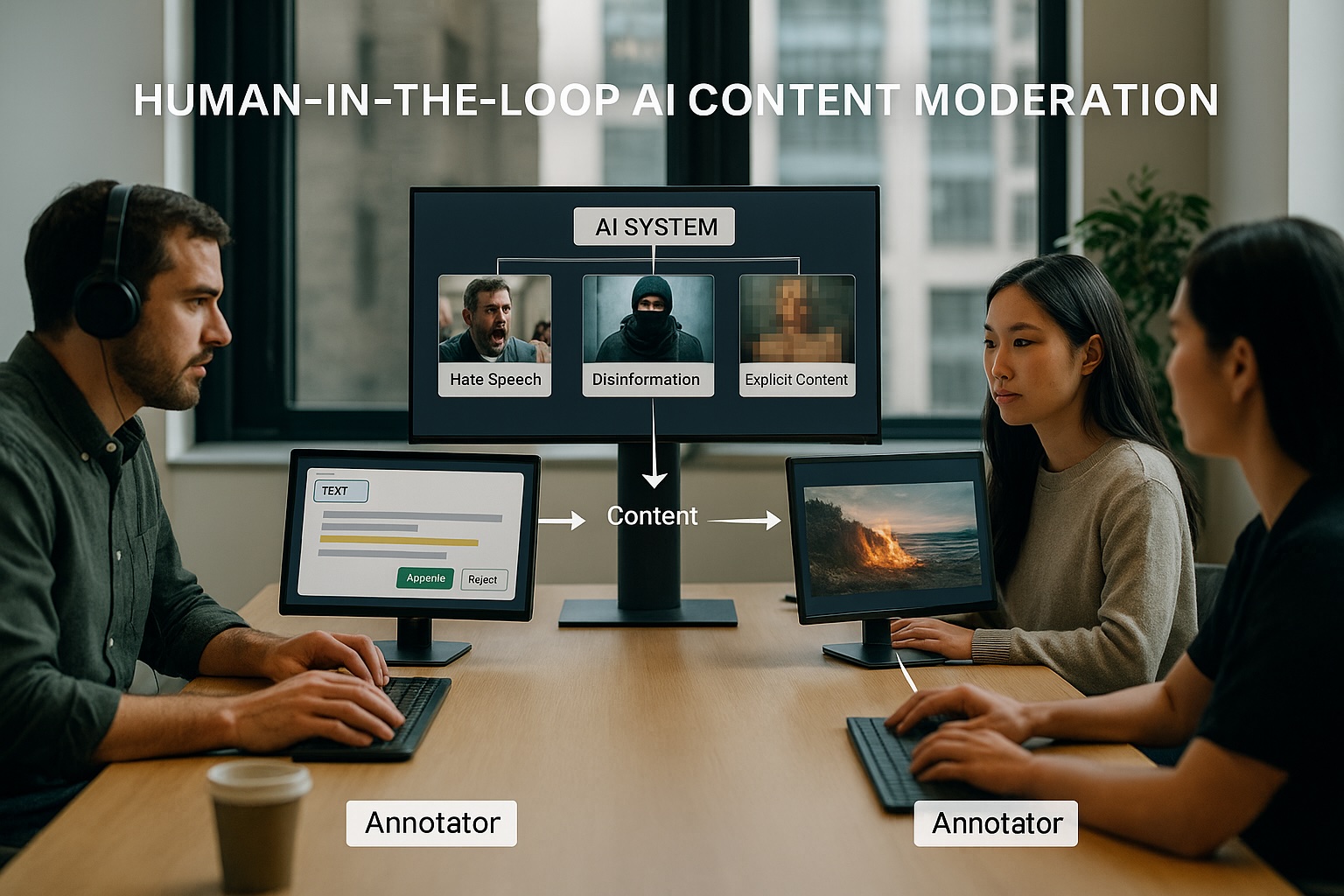
AI cannot recognize harmful content without carefully labeled examples. Effective moderation requires annotation that accounts for linguistic subtleties, cultural context, tone, and visual cues. Poorly annotated datasets result in models that over-censor or under-detect, eroding trust and amplifying risks. Human expertise is essential to ensure that moderation models are context-aware and reliable.
The Centaur.ai Approach
Centaur.ai is designed to deliver annotation pipelines that combine scale with precision:
- Expert annotators: Vetted professionals, not open crowdsourcing, provide consistent and informed labels.
- Gamified quality control: Annotations are continuously validated and scored, rewarding accuracy and filtering out errors.
- Smart consensus: Sensitive or complex tasks are reviewed by multiple experts, with labels finalized by consensus.
- Multimodal support: From text to images and video, Centaur.ai enables nuanced annotations across all content types.
Real-World Applications
- Text moderation for hate speech: Detecting coded or sarcastic language with cultural context.
- Image moderation for graphic content: Differentiating between acceptable and explicit imagery.
- Video analysis for disinformation: Accurately labeling misleading or harmful messages across layered media.
- Child safety compliance: Annotating with legal and cultural nuance to safeguard minors globally.
Building Ethical, Responsible AI
Moderation is not just a technical problem; it is an ethical one. Poor training data can introduce bias, suppress valid expression, or miss harmful content. Centaur.ai prioritizes fairness and transparency, ensuring diverse annotator pools, auditable QA processes, and compliance with standards like GDPR and HIPAA. Our pipelines are built for security, accountability, and adaptability.
Scaling Responsibly and Adapting Rapidly
Threats evolve quickly—deepfakes, AI-generated content, and election-related misinformation are already testing moderation systems. Centaur.ai provides dynamic pipelines that can adapt to emerging categories, allowing models to be retrained quickly and responsibly.
Improving the User Experience
The goal of moderation is not only to remove harmful content but also to create environments where users feel safe and respected. High-quality training data leads to fewer errors, fewer appeals, and stronger trust between platforms and their communities.
Building Trust Through Better Data
Platforms today face the challenge of balancing scale, speech, safety, and bias. That balance cannot be achieved with automation alone. Centaur.ai provides the foundation for moderation systems that are responsible, adaptive, and effective—powered by human understanding and strengthened by expert data annotation.
For a demonstration of how we can facilitate your AI model training and evaluation with greater accuracy, scalability, and value, Schedule a demo with Centaur.ai